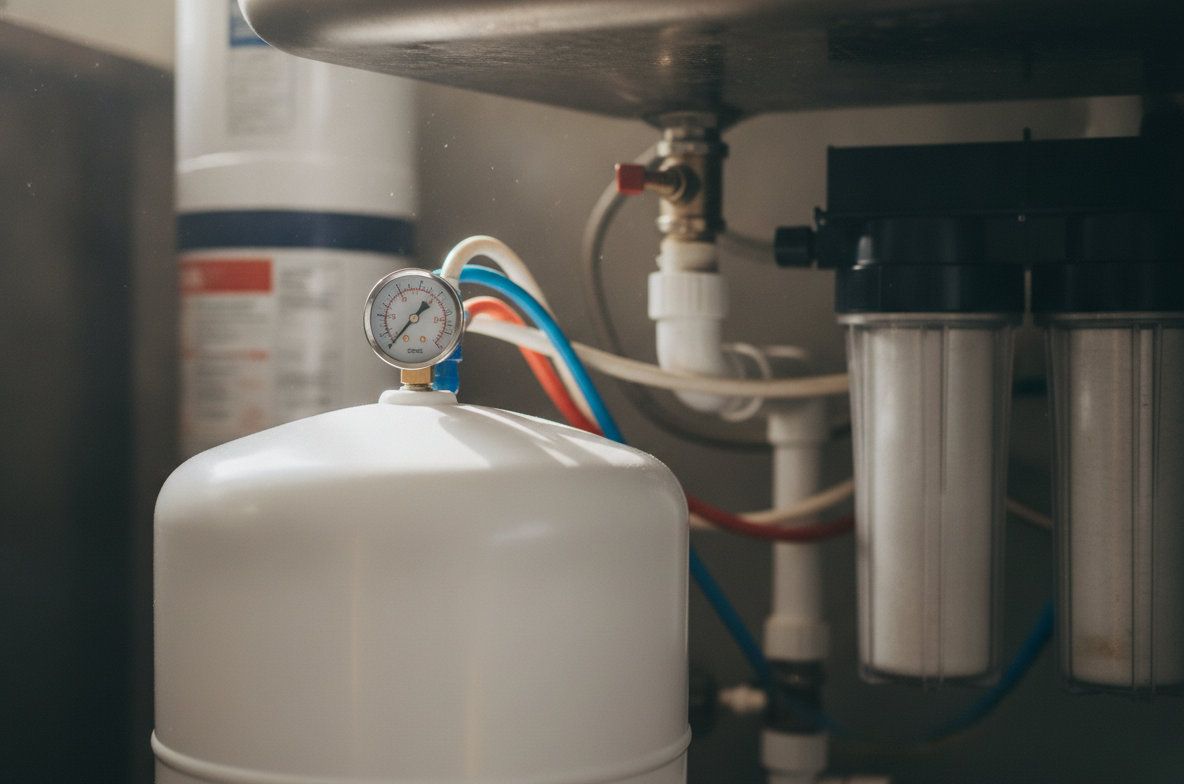
A reverse osmosis (RO) system's storage tank should feel heavy when full and dispense water at a steady rate. If your tank remains light or delivers only a trickle, the system is not producing enough water to fill it. Diagnosing the problem involves checking various components, from simple valve positions to the health of your filters and internal system parts.
1. Check the Valves First
Many RO tank filling problems stem from a valve that is not fully open. This is the single most common reason a reverse osmosis tank stays empty. Always start here before exploring more complex issues.
Storage Tank Valve
The valve on top of the RO storage tank controls the flow of purified water into and out of the tank. This valve must be in the fully open position for the tank to fill and dispense water. A handle in line with the tubing indicates it is open. A handle perpendicular to the tubing means it is closed. Confirm it is open.
Feed Water Valve
The feed water valve, usually a small ball valve or needle valve, connects your RO system to the cold water supply line. If this valve is even partially closed, it restricts the incoming water pressure and volume, preventing the tank from filling. Make sure the handle is fully open, aligning with the water line. If you just installed the system or changed filters, it is easy to forget to open this valve completely.
Shut-Off Valve on the Feed Water Adapter
Some RO systems use a feed water adapter with its own shut-off valve, typically located under the sink. This valve also needs to be fully open for water to reach the RO system. Confirm its position and open it if necessary.
2. Low Water Pressure
Reverse osmosis systems require a minimum amount of water pressure to operate effectively. Most residential RO systems need at least 40 psi (pounds per square inch) of incoming water pressure to produce water efficiently. If your home's water pressure is consistently below this threshold, the RO membrane will struggle to produce enough purified water to fill the tank.
You can check your home's water pressure with a simple pressure gauge attached to an outdoor spigot or laundry sink faucet. If the pressure is low, consider installing an RO booster pump. A booster pump costs between $150 and $300 and can significantly improve water production rates, especially in homes with low municipal water pressure or those relying on well water.
3. Clogged Pre-Filters or Membrane
The RO system relies on several filters to purify water. These include sediment filters, carbon block filters, and the RO membrane itself. If any of these filters become clogged, water flow to the tank will slow down or stop entirely.
Sediment and Carbon Filters
The sediment and carbon pre-filters remove larger particles, chlorine, and other contaminants before water reaches the delicate RO membrane. These pre-filters typically need replacement every 6 to 12 months. When they become saturated with contaminants, water cannot pass through them efficiently. This reduces the flow to the RO membrane and subsequently to the storage tank. New replacement pre-filter sets usually cost $30 to $60.
RO Membrane
The RO membrane is the heart of the system, responsible for removing the majority of dissolved solids. Membranes have a longer lifespan, often lasting 2 to 5 years, but they can foul prematurely if pre-filters are not changed on time or if the incoming water has high levels of hardness or sediment. A clogged membrane will drastically reduce water production. A working membrane should produce a steady, thin stream of purified water at its outlet, not just drips. Compare this flow rate to the membrane's GPD (gallons per day) rating. A new RO membrane typically costs $40 to $100.
Always consult your manufacturer's performance data sheet for specific contaminant removal claims and NSF/ANSI certifications. Understanding water filter certifications can help you verify system performance.
4. Faulty Automatic Shut-Off Valve (ASO Valve)
The automatic shut-off (ASO) valve is a critical component that stops the flow of feed water to the RO membrane once the storage tank is full. This prevents continuous water waste down the drain. If the ASO valve malfunctions, it might prematurely shut off the water flow, even when the tank is not full, or it might fail to open properly. This can prevent the tank from filling.
To test the ASO valve, close the tank valve and open the RO faucet to relieve pressure. Then, disconnect the tubing from the output side of the ASO valve (the line going to the tank). If water flows steadily from the ASO valve outlet, it is likely working. If there is no flow or a very slow drip, the ASO valve may be faulty and needs replacement. An ASO valve typically costs $15 to $30.
5. Failed Check Valve
The check valve is a small, one-way valve located on the purified water line, usually near the RO membrane housing, where the line connects to the tank. Its purpose is to prevent purified water from flowing backward out of the storage tank and into the drain line. If this valve fails, water from the tank can backflow, causing a continuous trickle down the drain and preventing the tank from building pressure or filling properly.
To test the check valve: with the tank full and the RO faucet closed, turn off the feed water. If water keeps running out of the drain line, the check valve is letting tank water flow backward and should be replaced. A replacement check valve costs about $10 to $20.
6. Problem with the Flow Restrictor
The flow restrictor is a small component located on the RO system's drain line. It creates back pressure on the RO membrane, forcing more purified water through the membrane and sending a controlled amount of wastewater to the drain. The flow restrictor sets how much water goes to drain and keeps pressure on the membrane.
A missing or oversized restrictor sends too much water down the drain and cuts water production. This means less water is available to fill the tank. Conversely, a clogged or undersized one sends too little to drain and fouls the membrane faster, though it does not cause an early shut-off. If the flow restrictor is not correctly sized or becomes clogged, it can negatively impact the system's efficiency and prevent the tank from filling. Replacing a flow restrictor costs around $5 to $15.
7. Ruptured Storage Tank Bladder
The RO storage tank contains an internal air bladder that pushes purified water out when the faucet is opened. This bladder is pre-charged with air, typically 5 to 7 psi, when the tank is empty. If this bladder ruptures, the tank loses its ability to push water out or hold pressure, and it will not fill correctly.
To test the tank's air pre-charge, first drain all water from the tank by opening the RO faucet until it stops. Then, use a tire pressure gauge on the Schrader valve (the bicycle tire-like valve) on the side of the tank. If the gauge reads significantly below 5 psi, or if water comes out of the air valve, the bladder has failed. In either case, the entire tank needs to be replaced.
Shut off the feed water, drain the old tank, disconnect it, and install the new one. Always make sure to shut off the water supply before attempting any disconnections. If you are unsure about cutting into supply lines, consider hiring a licensed plumber.
Recommended Replacement RO Storage Tanks
APEC Water Tank-4, 4 Gallon Pre-Pressurized Water Storage Tank (Top Pick)
This pre-pressurized 4-gallon water storage tank is a reliable option for most residential reverse osmosis systems. It holds up to 3.2 gallons of usable water and features a food-grade bladder. The tank is designed to discharge efficiently whether positioned vertically or horizontally, and it includes a tank stand for stable placement. It is certified to ensure quality, safety, and durability, making it a robust choice for restoring your RO system's water storage.

- Pre-pressurized 4 gallon water storage tank (holds up to 3.2 gallon of water)
- Discharge efficiently in a vertical or horizontal position with tank stand
- Food grade bladder and certified to ensure quality, safety and durability
- Inlet/outlet connection: 1/4 inch male pipe thread. Special designed for ro application
Neo-Pure Reverse Osmosis Storage Tank, 3.2 Gallon Nominal Capacity
Designed for compact spaces, this Neo-Pure tank offers a 3.2-gallon nominal air capacity, providing approximately 2.0 to 2.3 gallons of usable water depending on your system's pressure. Its smaller size makes it suitable for limited under-sink cabinet space, and it works with most residential reverse osmosis systems that use standard tubing connections. It is a practical choice when cabinet room is a concern.

- 3.2-gallon nominal air capacity provides approximately 2.0 to 2.3 gallons of usable water depending on system.
- Smaller tank size designed for limited under-sink cabinet space.
- Works with most residential reverse osmosis systems using standard tubing connections.
- Powder-coated exterior and internal liner for long term reliability.
Neo-Pure Reverse Osmosis Storage Tank - White Powder-Coated Stainless Steel
For those seeking enhanced durability and resistance, this Neo-Pure tank features a white powder-coated stainless steel exterior. It includes a stainless steel water connection, a high-grade chlorobutyl diaphragm, and a virgin polypropylene liner. The virgin polypropylene liner ensures the water remains tasteless, odorless, and free from contaminants, while the advanced chlorobutyl diaphragm is post-cured for enhanced performance and long term reliability. This tank offers a premium build for lasting service.

- Stainless steel water connection High-grade chlorobutyl diaphragm Virgin polypropylene liner Plastic tank.
- High quality virgin polypropylene liner ensures water remains tasteless, odorless, and free from contaminants.
- Advanced chlorobutyl diaphragm, post-cured for enhanced performance and long term reliability.
- Reliable and efficient design, ideal for both residential and commercial reverse osmosis systems.
When to Call a Professional
Most RO troubleshooting steps involve inspecting and replacing individual components, which many homeowners can handle. However, if you have checked all the common issues and the tank still does not fill, or if you encounter persistent leaks after replacing parts, it may be time to call a licensed plumber or an RO system specialist. Complex pressure issues, multiple component failures, or an inability to identify the source of a leak can warrant professional assistance. Professional service for RO system repair can range from $75 to $200 per hour, plus parts.
Diagnosing why your reverse osmosis tank is not filling often involves a systematic check of valves, filters, and other key components.